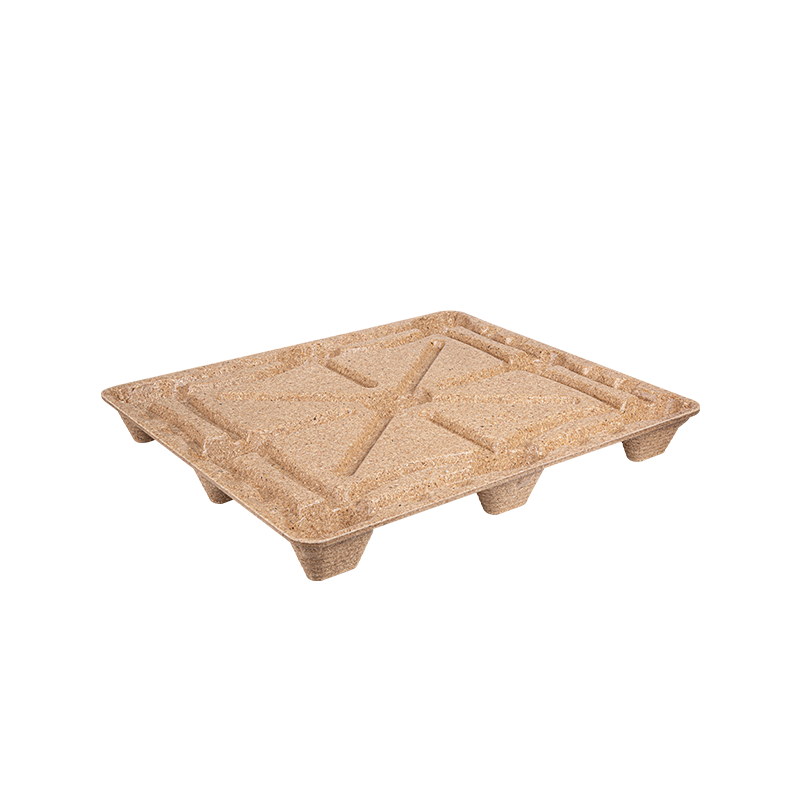
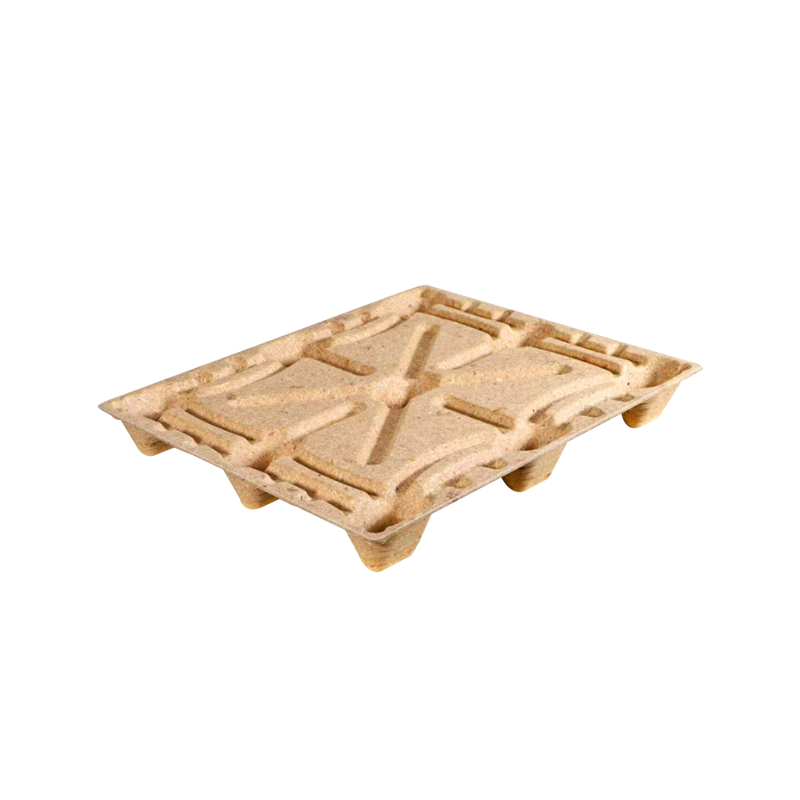
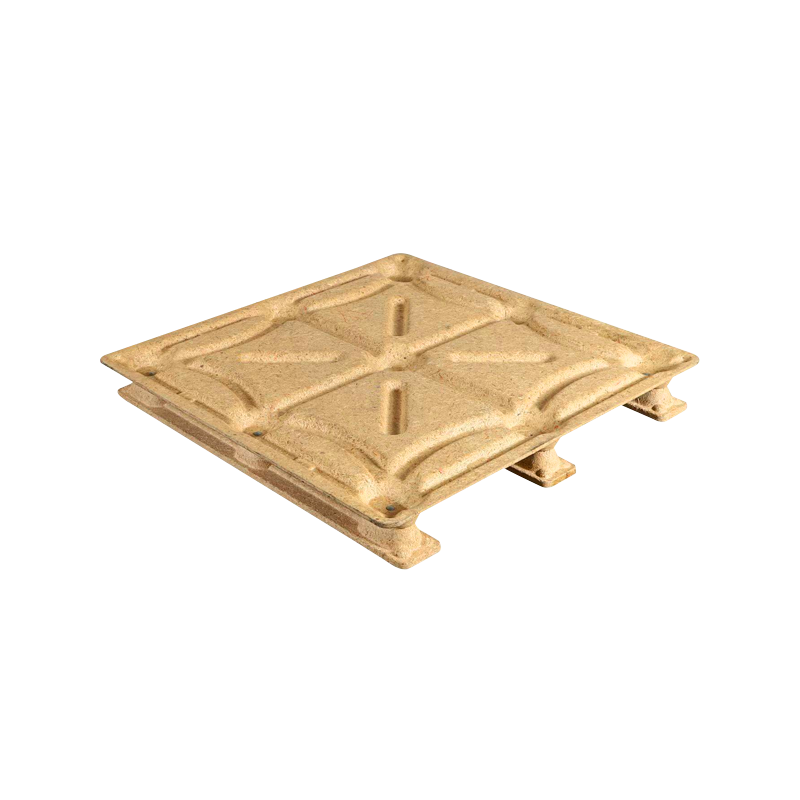
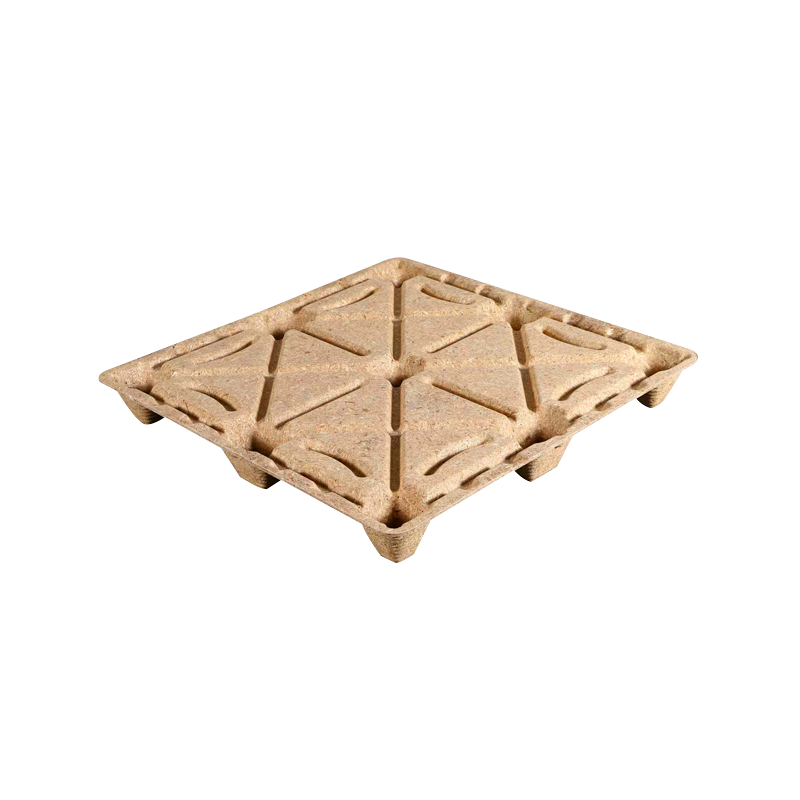
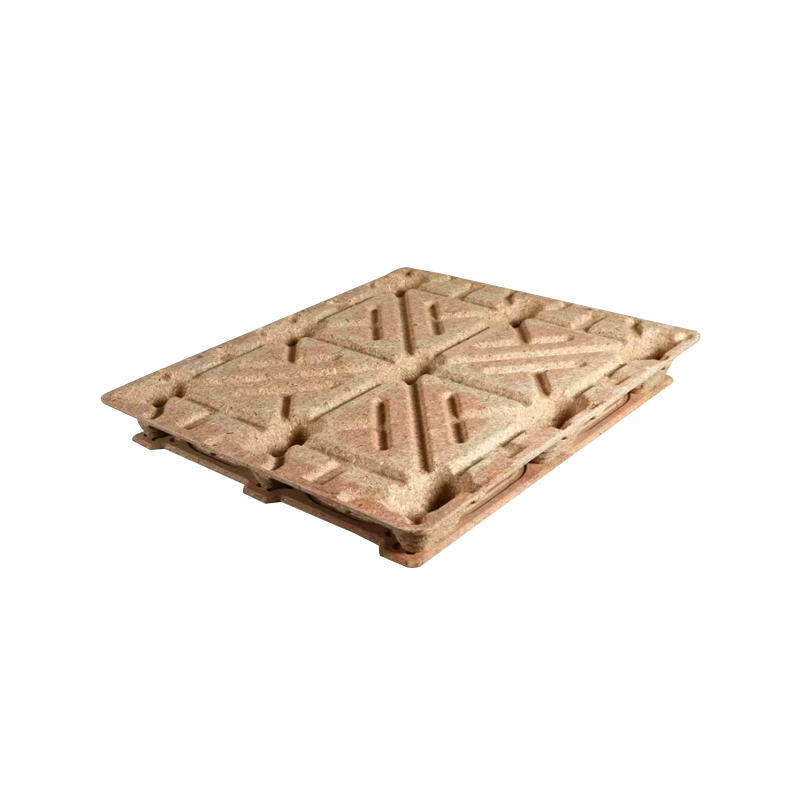
Molded wood pallets, also known as presswood pallets, pressed wood pallets, or compressed wood pallets , are produced by combining prepared wood particles or fibers with a binder and forming the mixture inside a heated mold under pressure.
Unlike conventional nailed wooden pallets, the pallet deck, support ribs, feet, and fork-entry geometry can be formed as one integrated structure. This manufacturing approach makes it possible to reduce loose components, control pallet geometry, create nestable designs, and utilize sawdust, wood shavings, recycled wood fiber, and other suitable wood-processing residues.
For pallet buyers and manufacturers, however, successful molded wood pallet shaping depends on much more than simply increasing press pressure. Feedstock moisture, particle distribution, binder chemistry, mold temperature, charge weight, mold geometry, curing time, and cooling all interact.
This guide explains the major engineering considerations involved in designing and manufacturing molded wood pallets for logistics and export applications.

1. Molded Wood Pallet Manufacturing Process and Critical Shaping Parameters
A typical molded pallet line follows a controlled sequence:
Raw Material Preparation → Crushing and Screening → Drying and Moisture Conditioning → Adhesive Mixing → Charge Weighing → Mold Filling → Hot Pressing → Curing → Demolding → Cooling → Inspection
Raw Material Preparation
Wood chips, sawdust, shavings, and recycled wood normally need to be processed into a reasonably consistent particle distribution before molding.
Excessively large pieces can prevent uniform cavity filling, while an excessive proportion of fines may increase binder demand and reduce permeability during hot pressing.
Moisture control is especially important. Published molded-wood processes commonly use material below approximately 10% moisture, although some binder systems and production routes operate at different levels. The optimum value should therefore be established through trials rather than copied from another production line.
Typical Development Windows
The following values should be treated as starting points for process development, not universal specifications .
| Feedstock Condition | Starting Moisture Range | Mold Temperature | Effective Forming Pressure | Typical Development Cycle |
| Fine sawdust / wood fiber | 5–10% | 150–200°C | 2–5 MPa | 2–6 min |
| Mixed recycled wood particles | 6–10% | 160–210°C | 2.5–5 MPa | 3–8 min |
| Coarser flakes / strands | Binder-dependent | 150–220°C | 2–5 MPa | 3–10 min |
Historical molded-wood processes report molding temperatures around 150–220°C , pressures of approximately 20–80 kg/cm² , and molding times ranging from seconds to several minutes. Other molded wood-strand systems use roughly 300–700 psi with press cycles of approximately 2–10 minutes , depending on thickness, density, moisture, and binder chemistry.
The important point is that wood species alone should not determine press settings . Particle size, bulk density, binder, pallet thickness, rib depth, mold design, and charge distribution are often equally important.
Recommended Production Monitoring
For a new line, useful QC checkpoints include:
- Feedstock moisture: each incoming batch and at least hourly during production
- Binder dosage: each formulation batch
- Charge weight: first-off pieces and periodic checks during each shift
- Mold temperature: continuously recorded
- Press pressure and dwell time: recorded for every cycle where PLC data logging is available
- Critical dimensions: first article plus scheduled in-process sampling
- Pallet weight: periodic SPC sampling to identify charge variation
- Destructive load tests: according to the approved production validation plan
Process optimization should use actual dimensional, density, moisture, and load-test results to define the acceptable manufacturing window.
2. Mold Design and Tooling for Nestable Molded Wood Pallets
The mold determines much more than pallet appearance. It controls material flow, structural stiffness, nesting efficiency, fork accessibility, local density, and demolding reliability .
Important design elements include:
Draft Angles
Vertical walls and deep pallet feet require sufficient draft to release cleanly from the mold. A preliminary design may begin around 1–3 degrees , with additional draft considered for deeper nesting features or surfaces susceptible to sticking.
Ribs and Reinforcement
Instead of simply making the entire pallet thicker, reinforcement should be concentrated around:
- fork-entry zones;
- pallet feet;
- deck transitions;
- high bending-moment regions;
- load-transfer paths between deck and supports.
Smooth transitions and generous internal radii help reduce stress concentrations and improve material flow.
Nesting Geometry
For nestable pallets, engineers should check:
upper deck clearance leg taper nesting depth separation clearance stacked pallet height
A pallet that nests too tightly may be difficult to separate after storage, while excessive clearance wastes transportation volume.
Venting and Material Flow
Deep cavities can trap vapor or prevent material from reaching corners. Mold venting, feed distribution, and local charge placement should therefore be evaluated before production tooling is finalized.
Useful engineering files commonly include:
- STEP
- IGES
- Parasolid
- DXF for 2D profiles and inspection drawings
Before manufacturing a full production mold, manufacturers can use 3D-printed geometry models, machined prototype inserts, or aluminum development tools to verify pallet dimensions, fork clearances, nesting, and package fit.
A basic mold-design review should ask:
- Can the pallet release without damaging ribs or feet?
- Is the charge able to reach every deep cavity?
- Are critical areas thick enough without unnecessary material?
- Can worn areas be replaced using inserts?
- Are heating zones balanced?
- Can vents and mold surfaces be cleaned easily?
- Can critical dimensions be measured using repeatable gauges?
3. Wood Feedstocks, Adhesives and U.S. Compliance Considerations
Raw material cost is one of the attractions of molded pallet production because suitable processes may utilize sawdust, wood shavings, recovered wood particles, and other clean wood-processing residues .
However, recycled feedstock must be controlled.
Metal fragments, plastics, paint, excessive bark, soil, or chemically contaminated waste can interfere with molding and may create compliance or quality problems.
Binder Selection
Common binder families in engineered wood applications include phenolic systems and isocyanate-based binders such as MDI.
| Binder Consideration | Phenolic-Type Binder | MDI-Type Binder |
| Moisture resistance | Good | Very good |
| Structural bonding | Good | High |
| Cure conditions | Heat dependent | Highly formulation dependent |
| Formaldehyde contribution | Must be evaluated | No added formaldehyde from the isocyanate itself |
| Processing sensitivity | Moderate | Requires careful moisture and handling control |
| Cost | Often competitive | Often higher |
The correct formulation should balance mechanical strength, moisture resistance, processing time, emissions requirements, recyclability, and cost.
TSCA Title VI and CARB
A common mistake is to state that every molded wood pallet is automatically regulated under TSCA Title VI .
EPA specifically regulates composite wood product categories including hardwood plywood, medium-density fiberboard, and particleboard , together with applicable finished goods containing those regulated products. Therefore, a molded pallet manufacturer should determine whether its specific material construction falls within the regulatory definitions rather than automatically claiming that all molded pallets require TSCA Title VI certification.
For U.S. projects, procurement and compliance teams should review:
- feedstock classification;
- binder chemistry;
- supplier SDS and technical documentation;
- applicable formaldehyde requirements;
- recycled-content documentation;
- FSC or SFI sourcing requirements where specified by the buyer.
ISPM 15 and Processed Wood
ISPM 15 primarily addresses phytosanitary risks from raw wood packaging material used in international trade.
The IPPC standard excludes wood packaging manufactured from wood that has been processed in a manner that makes it effectively free from pest risk, with plywood given as a typical example.
This processed-wood principle can be an important advantage for properly manufactured molded or presswood pallets. However, exporters should confirm the classification of the specific pallet and the requirements of the destination country instead of relying only on a marketing statement.
4. Trimming, Dimensional Tolerances and Pallet Performance Testing
After demolding and cooling, pallets may require edge trimming, flash removal, drilling, identification marking, sanding, or other finishing operations.
For repeat production, CNC trimming can provide consistent:
- pallet length and width;
- fork openings;
- corner geometry;
- locating features;
- custom cut-outs.
Rather than applying unnecessarily tight machining tolerances to the entire pallet, the drawing should identify critical-to-function dimensions .
For example, a development drawing might target approximately ±1–2 mm on selected controlled dimensions and ±2–3 mm on larger overall dimensions , but actual tolerances must be confirmed by mold capability studies and production data.
Pallet Performance Validation
Important tests may include:
- static compression;
- deck bending;
- dynamic handling;
- fork-lift handling;
- impact or drop resistance;
- stacking stability;
- racking simulation where the pallet is intended for rack use;
- moisture-conditioning tests.
The current ISO 8611-1:2025 specifies methods for evaluating new flat pallets, including nominal-load testing, maximum-working-load testing, and durability comparison. ISO 8611-2:2025 addresses performance requirements and test selection.
For U.S. applications, ASTM D1185-98a(2025) provides static compression, bending, and dynamic test methods for pallets manufactured from materials including solid wood and wood composites. ASTM also recommends field testing to verify performance in the intended distribution environment.
For customers using the common 48 × 40 in U.S. pallet footprint , compatibility should also be checked against the customer’s forklifts, pallet jacks, conveyors, racks, stretch-wrapping systems, and warehouse automation.
5. Scaling Molded Pallet Production: Cost, Throughput and Troubleshooting
A successful prototype does not automatically produce an economical production line.
When scaling from pilot production to multiple shifts, manufacturers should track:
cycle time, uptime, mold availability, changeover time, dryer capacity, adhesive mixing capacity, labor, scrap rate, and cooling time.
A simple unit-cost model can be written as:
Unit Cost = Wood Feedstock Binder Energy Labor Maintenance Scrap Mold Amortization Equipment Depreciation
For mold investment:
Mold Cost per Pallet = Total Mold Investment ÷ Expected Lifetime Production
A production model should therefore include:
| Cost / Production Variable | Input |
| Press cycle time | min/cycle |
| Cavities per mold | pcs |
| Operating hours | hr/day |
| OEE | % |
| Working days | days/year |
| Annual production | pallets/year |
| Wood consumption | kg/pallet |
| Binder consumption | kg/pallet |
| Electricity / thermal energy | per pallet |
| Scrap rate | % |
| Mold investment | USD |
| Expected mold life | cycles |
This allows buyers to compare the economics of one press with multiple molds, multiple presses, or higher levels of automation.
Common Molding Defects
| Defect | Possible Cause | First Check | Corrective Action |
| Incomplete fill | Insufficient charge or poor distribution | Charge weight | Rebalance charge placement |
| Surface voids | Moisture or binder inconsistency | Moisture and mixing | Correct drying and mixing |
| Warpage | Uneven heating or cooling | Mold temperature map | Balance heating and cooling |
| Weak ribs | Poor material flow | Rib cavity filling | Modify distribution or mold geometry |
| Delamination | Incomplete cure | Cycle and binder | Adjust cure conditions |
| Excess flash | Overcharge or mold wear | Closing surfaces | Reduce charge or service mold |
Trend data should be used whenever possible. A gradual increase in pallet weight, flash, temperature variation, or dimensional drift can reveal a process problem before major failures occur.
Developing a Custom Molded Wood Pallet with Ronsun
The most effective molded pallet design starts with the actual logistics application.
When discussing a new pallet project with Ronsun Import & Export Co., Ltd. , useful information includes:
- required pallet length, width, and height;
- static and dynamic load requirements;
- forklift and pallet-jack entry;
- floor, stack, or rack storage conditions;
- nesting requirements;
- export destinations;
- annual purchasing volume;
- environmental or recycled-content requirements;
- required testing or compliance documentation.
Ronsun can work with buyers to evaluate pallet specifications, molded pallet structures, material options, sample requirements, and custom project needs.
For custom molded wood pallet sourcing or technical evaluation, contact Ronsun Import & Export Co., Ltd. through ronsun-ecopallet.com with your pallet drawing, target load, application, and expected purchasing volume.
FAQ
What pressure, temperature, and cycle time are typically used for molded wood pallets?
Published molded-wood processes cover wide ranges, but approximately 150–220°C, 2–5 MPa, and several minutes per cycle can be used as an initial development reference. Final parameters must be validated for the specific feedstock, binder, thickness, and mold.
How should a nestable molded wood pallet mold be designed?
The mold should account for draft angle, tapered feet, nesting clearance, reinforcement ribs, fork-entry geometry, material flow, venting, heating uniformity, and demolding.
Which adhesive is best for U.S. molded pallet applications?
There is no single best binder. MDI-based systems can provide strong moisture-resistant bonding, while phenolic systems are well established for durable engineered wood. Selection should consider performance, process conditions, emissions, cost, and regulatory applicability.
What standards are used to test molded pallet load capacity?
Common references include ISO 8611-1:2025, ISO 8611-2:2025, and ASTM D1185-98a(2025) . The appropriate test sequence depends on the intended handling and storage environment.
How is molded pallet ROI calculated?
Estimate annual output first, then calculate feedstock, binder, labor, energy, maintenance, scrap, equipment depreciation, and mold amortization per pallet. Compare the resulting unit cost with the current pallet purchase and logistics cost.
What are the most common molded pallet defects?
Typical problems include incomplete cavity filling, surface voids, excessive flash, weak ribs, delamination, sticking, and warpage. Troubleshooting should begin with charge weight, moisture, binder dosage, mold temperature, pressure history, and cooling conditions.
 English
 Français
 Español
 عربى
عربى